PassCode
First time doing a blockchain challenge. I had no idea what to expect going in. The description says there is a smart contract running on a private blockchain and my goal is to make a function called isSolved() return true. That is it. No source code, no hints upfront, just a contract sitting on a blockchain waiting to be poked.
Start the machine, wait a couple of minutes, then run all 7 setup commands to get the environment ready. After that you are good to go.
Figuring Out What We Are Dealing With
First thing I did was hit the challenge API to see what info it gives back:
curl -s $API_URL/challenge | jq
$API_URL/challenge is the challenge API endpoint and jq just formats the JSON so it does not look like a wall of text. Nothing groundbreaking here but it confirms the setup is working.
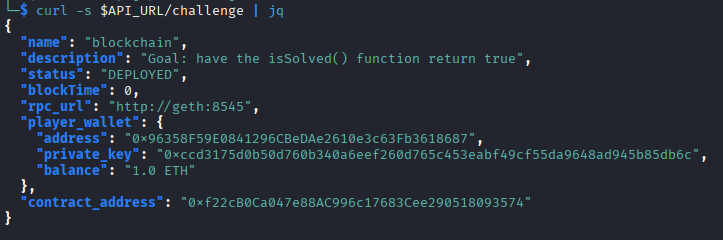
Now since there is no source code provided, I need to reverse engineer the contract. Every smart contract on a blockchain is stored as bytecode. It looks like complete gibberish but it actually contains function selectors which are short 4 byte fingerprints of every function inside the contract. Think of it like this:
source code > compiler > bytecode
To grab the raw bytecode I ran:
cast code $CONTRACT_ADDRESS --rpc-url $RPC_URL
Got the bytecode. Now I need to make sense of it.
Decompiling the Bytecode
Copy the whole bytecode output and paste it into https://app.dedaub.com/decompile. Once it processes, the most important part is at the top which is the function routing table.
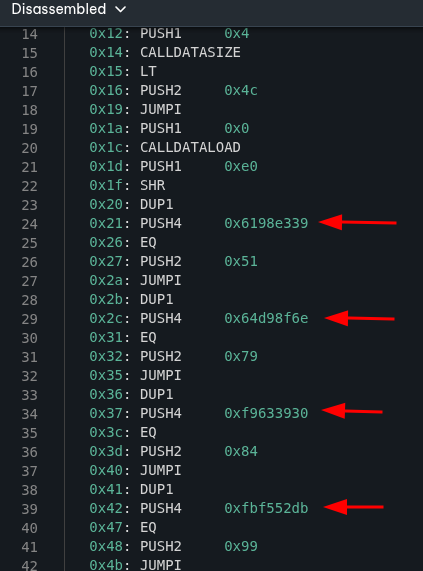
What is happening there is pretty straightforward. When someone calls the contract, it looks at which function is being called, compares it against a list of 4 byte selectors, and jumps to the matching code. So the caller says “I want function 0x6198e339”, the contract checks its list, finds the match, and runs it.
Now I need to decode those selectors into actual human readable names. I ran cast 4byte on each one:
cast 4byte 0x6198e339
cast 4byte 0x64d98f6e
cast 4byte 0xf9633930
cast 4byte 0xfbf552db
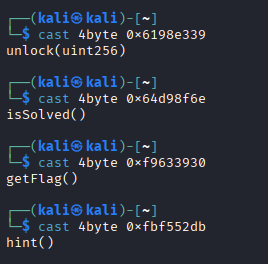
And got back:
0x6198e339  ->  unlock(uint256)
0x64d98f6e  ->  isSolved()
0xf9633930  ->  getFlag()
0xfbf552db  ->  hint()
Now I know exactly what this contract can do. isSolved() checks if the challenge is complete. unlock(uint256) takes a number as input and is clearly the key to everything. getFlag() gives the flag once solved. And hint() which is going to give us a hint.
Getting the Hint
cast call $CONTRACT_ADDRESS "hint()(string)" --rpc-url $RPC_URL

It straight up told me the code is 333. Ok then. That was easier than expected. I was half expecting some cryptic riddle.
Unlocking the Contract
Now lets call unlock(uint256) with 333 and see what happens:
cast send $CONTRACT_ADDRESS "unlock(uint256)" 333 --rpc-url $RPC_URL --private-key $PRIVATE_KEY --legacy
This sends a transaction to the blockchain, passes in the code from the hint, and signs it with my wallet using the private key. The --legacy flag is needed for compatibility with older transaction formats.
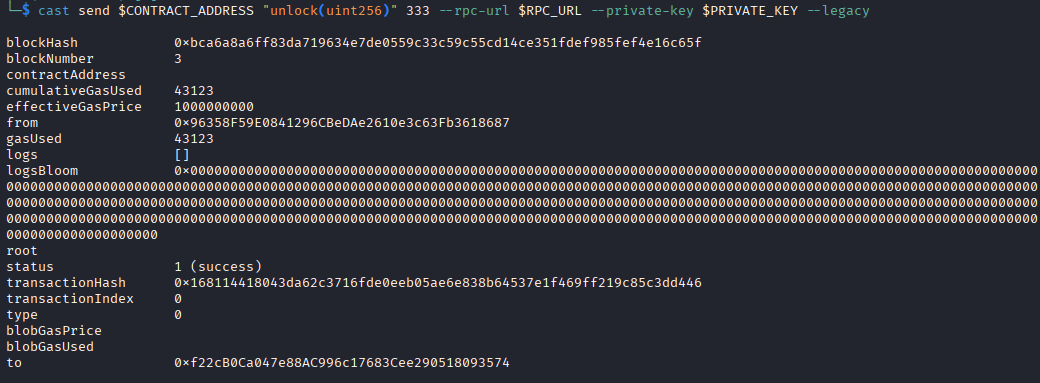
Transaction went through.
Now lets check if that actually did anything:
cast call $CONTRACT_ADDRESS "isSolved()(bool)" --rpc-url $RPC_URL

true. Nice.
Getting the Flag
cast call $CONTRACT_ADDRESS "getFlag()(string)" --rpc-url $RPC_URL
Flag: THM{web3_h4ck1ng_code}

This was a short one but genuinely interesting. I had never touched a blockchain challenge before and going in blind with no source code felt kind of intimidating. Reverse engineering the bytecode through a decompiler and decoding the function selectors was a cool process. Once I had the function names it basically walked itself. The hint function giving away the answer directly was funny. But hey, I will take it.